

Trinitario
A genetically diverse group of cacao varieties that originated from crosses between Criollo and Forastero cacao and typically combines the flavor potential of Criollo with the vigor and disease resistance of Forastero.
Inherited from Criollo:
-
Balanced Flavor, fruity, floral, complex
-
Market Position: valued for fine/flavor cocoa segment, often accepted by specialty chocolatiers
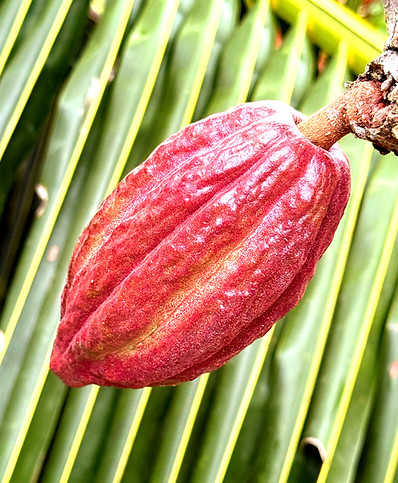
Inherited from Forastero:
-
Higher Yield: more productive than Criollo, though usually not as high as Forester
-
Greater Disease Resilience
-
Wider Adaptability: grows in more regions and climates compared to fragile Criollo
Trinitario Clones

PG610
UF18
W10
BR25
Philippine cacao genetics (including clones such as UF18, BR25, W10, and PG610) sit within the broader global reality that cacao is not cleanly divided into Criollo, Forastero, and Trinitario, but instead exists as a mosaic of highly mixed genetic lineages. Most commercial cacao origins are genetically complex populations shaped by historical introductions, local selection, and natural cross-pollination, making precise genetic identity difficult without lab-level DNA testing. In the Philippines, this is especially true because many NSIC-registered clones are distributed widely and interplanted, meaning even “named clones” often behave more like genetically variable populations in practice.
From available studies on Philippine material, UF18, BR25, and W10 have been DNA-fingerprinted as distinct but broadly Trinitario-derived hybrids, with influences from Upper Amazon (Forastero-type) and Amelonado backgrounds. UF18 is often linked to high vigor and fat content, BR25 to more Amelonado-like morphology and productivity traits, and W10 stands out for unusually strong fine-aroma volatile compounds, though its exact pedigree remains unclear. PG610 is widely described as Trinitario in industry sources but lacks published molecular pedigree data, reflecting a common pattern in Southeast Asian cacao where formal breeding records are incomplete or not publicly accessible.
Overall, the key takeaway is that Philippine cacao genetics are best understood as a managed hybrid system rather than discrete “pure clones.” Even when clones are named and distributed, real-world farms often contain genetic overlap due to pollination and propagation practices, and the resulting flavor expression depends as much on terroir, fermentation, and selection pressure as on the underlying genotype.
International Cocoa Award (ICA) winners 2019, at the Salon du Chocolat in Paris, France
“Best Cacao Beans in the World” at Chocoa in Amsterdam, Netherlands, 2022
4 Golds + 1 Bronze at the 2020 World Drinking Chocolate Competition by the International Chocolate Awards, Hannover, Germany, 2020

